For many couples, the journey to parenthood is expected to be natural and effortless. So when pregnancy doesn’t happen as planned, it can bring confusion, anxiety, and even self-doubt.
As a gynaecologist, I meet many couples who silently carry this emotional burden—often blaming themselves or feeling isolated. But I want you to know this:
Infertility is common, it is medical, and most importantly—it is treatable.
With the right evaluation and guidance, there are multiple paths that can lead you to your goal of having a child.
What Does Infertility Really Mean?
Infertility is defined as the inability to conceive despite regular, unprotected intercourse:
- For 12 months if you are under 35
- For 6 months if you are above 35
This difference is important because fertility naturally declines with age, especially after 35.
It is also important to understand that infertility is not just a “woman’s problem.”
- About 40% of cases involve female factors
- 40% involve male factors
- And in some cases, both partners contribute
In nearly 10–15% of couples, all tests may appear normal—this is called unexplained infertility.
Why Does Infertility Happen?
Infertility can result from a variety of reasons, and identifying the cause helps us choose the right treatment.
Common Causes in Women
- PCOS (Polycystic Ovary Syndrome): A common hormonal condition that affects ovulation
- Blocked fallopian tubes: Prevent sperm and egg from meeting
- Endometriosis: Causes inflammation and scarring in the pelvic region
- Low ovarian reserve: Fewer eggs available, often seen with increasing age
- Hormonal imbalance: Disrupts ovulation and menstrual cycles
Common Causes in Men
- Low sperm count
- Poor sperm movement (motility)
- Abnormal sperm shape
- Hormonal issues
Many couples are surprised to learn how important male evaluation is in fertility assessment.
When Should You Seek Medical Help?
Timing matters in fertility.
You should consult a doctor if:
- You’ve been trying without success for the recommended duration
- Your periods are irregular or absent
- You’ve experienced repeated miscarriages
- You have known medical conditions like PCOS or thyroid disorders
- You are planning pregnancy after 35
Early consultation can make treatment simpler and more effective.
How Is Infertility Evaluated?
The evaluation process is straightforward and not as overwhelming as many fear.
For Women:
- Blood tests to check hormone levels
- Ultrasound scan to assess ovaries and uterus
- HSG (Hysterosalpingography) to check if fallopian tubes are open
For Men:
- Semen analysis to evaluate sperm count, movement, and quality
These basic tests provide valuable information and help us plan the next steps.
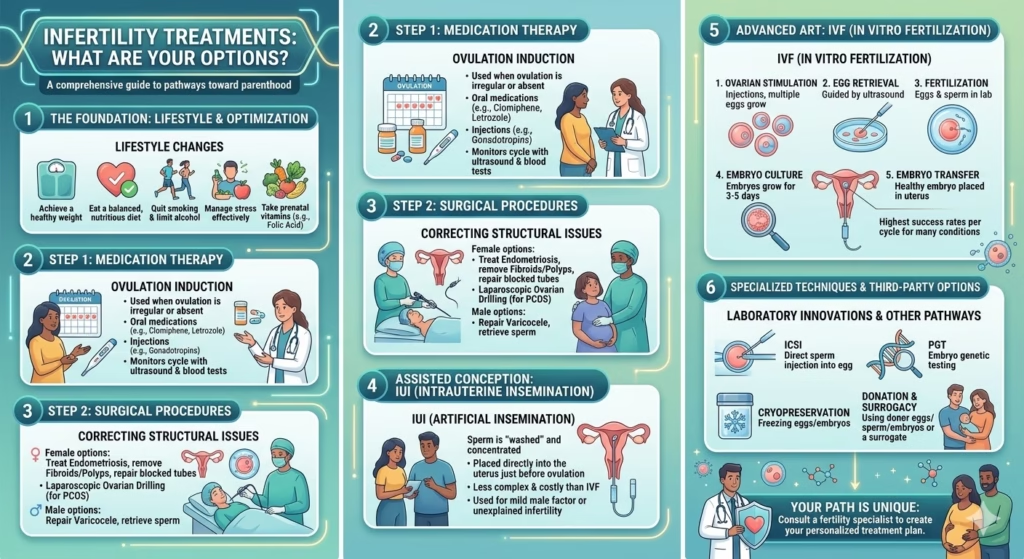
Understanding Your Treatment Options
Treatment is always step-by-step, starting from the simplest options and progressing only if needed.
1. Lifestyle & Medical Management
For some couples, improving lifestyle alone can significantly improve fertility.
- Maintaining a healthy weight
- Eating a balanced diet
- Regular physical activity
- Managing stress
- Stopping smoking and limiting alcohol
In addition, medications may be given to correct hormonal imbalances or regulate periods.
2. Ovulation Induction
If ovulation is irregular, we use medications to stimulate the ovaries.
- Helps the body release eggs regularly
- Often combined with timed intercourse
- Commonly used in PCOS
This is usually the first line of treatment.
3. IUI (Intrauterine Insemination)
IUI is a simple and less invasive procedure.
- Sperm is specially prepared in the lab
- It is then placed directly into the uterus
- This improves the chances of fertilization
It is helpful in:
- Mild male factor infertility
- Unexplained infertility
- Early treatment stages
4. IVF (In Vitro Fertilization)
IVF is one of the most advanced and effective treatments available today.
The process involves:
- Stimulating the ovaries to produce multiple eggs
- Retrieving the eggs through a minor procedure
- Fertilizing them with sperm in a laboratory
- Transferring the best embryo into the uterus
IVF is recommended when:
- Fallopian tubes are blocked
- Egg reserve is low
- Other treatments have failed
- There is severe male factor infertility
5. Advanced Fertility Techniques
In certain cases, more specialised treatments may be needed:
- ICSI (Intracytoplasmic Sperm Injection): Used when sperm quality is poor
- Donor eggs or sperm: When own gametes are not suitable
- Surrogacy: In selected medical situations
6. Fertility-Enhancing Surgeries
Some structural issues can be corrected through surgery:
- Removal of fibroids
- Treatment of endometriosis
- Clearing blocked tubes
This may improve chances of natural conception.
Choosing the Right Treatment
Every couple’s journey is unique.
The treatment plan depends on:
- Age of the woman
- Cause of infertility
- Duration of trying
- Overall health
It is important to remember:
Not everyone needs IVF. Many couples conceive with simpler treatments.
The Emotional Side of Infertility
Infertility is not just a medical condition—it is deeply emotional.
Couples may experience:
- Stress and anxiety
- Feelings of guilt or inadequacy
- Social pressure
It is important to:
- Communicate openly with your partner
- Seek emotional support
- Consider counseling if needed
Your mental health is just as important as your physical health.
Success Rates: Setting Realistic Expectations
Success depends on many factors:
- Age (most important factor)
- Egg and sperm quality
- Underlying medical conditions
Some couples conceive quickly, while others may need time and multiple attempts.
Patience and persistence are key.
Final Thoughts: There Is Always Hope
Infertility can feel like a long and uncertain road—but today, we have more tools, treatments, and knowledge than ever before.
With early diagnosis, the right treatment, and emotional support, many couples achieve their dream of parenthood.
If you are facing difficulties, don’t delay seeking help.
Sometimes, the smallest step—like a consultation—can change your entire journey.

Dr. Mamta Pattnayak is working as a Additional Director in Gynae and Obstetrics Dept. in Fortis Hospital, Gurgaon. Dr. Mamta Pattnayak is an MBBS graduate from S.C.B. Medical College, Cuttack and completed her MD (Obstetrics & Gynaecology) from Sambalpur University in 2003. With a rich experience of over years to her credit, Dr. Mamta has undergone training on advance lap Gynae by Ethicon. Done hand’s on Colposcopy course by RCOG. She is certified as a mentor in RCOG training course in Max Hospital Saket. Dr. Mamta has been associated with several organizations like Moolchand Hospital, New Delhi besides others. Her last assignment was at Max Super Specialty Hospital, Saket, New Delhi. Recently she has also started her private clinic at: Mother’s Touch HealthCare Centre: 395P, Sector 39 Rd, opposite to Medanta Hospital, near Gurudwara, Sector 39, Gurugram, Haryana 122004